
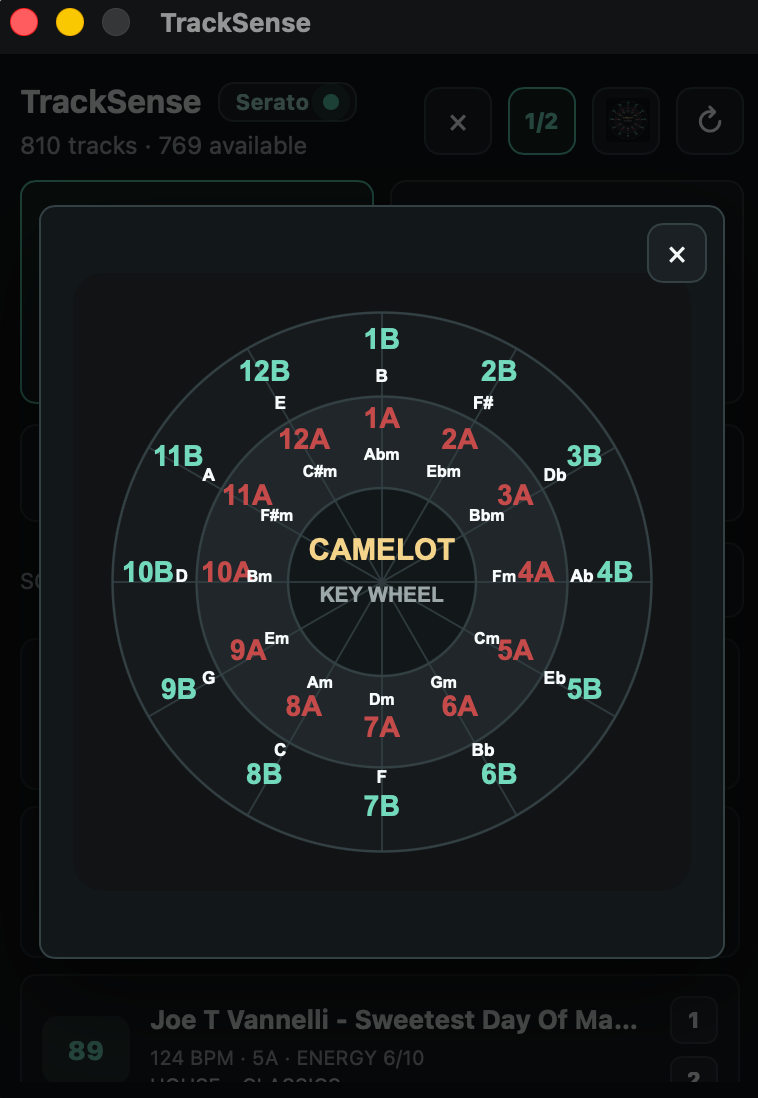
Use harmonic key as a shortlist, not a rulebook
Harmonic mixing is useful because compatible keys usually make a blend feel more settled. A Camelot key can quickly identify tracks in the same key, adjacent keys or relative major and minor positions. That makes it a strong first filter when a deck is playing and you need options quickly.
It should not decide the transition on its own. Two tracks can be compatible on paper and still clash because their vocals, chord changes, basslines or breakdowns compete. Equally, a deliberate key change can create exactly the lift a set needs. Treat key as a way to remove obviously awkward options, then listen to the musical character of the records that remain.
Keep BPM changes intentional
Matching BPM makes beatmatching straightforward, but it is the rate of change across a sequence that matters. Staying close to the current tempo keeps a groove stable. Moving a little faster can increase momentum; moving lower can give a room space before a new section of a set. A sensible shortlist starts with tracks at the current BPM and then includes a small range either side.
Genre also affects what feels natural. A one or two BPM change can be noticeable in a tight house mix, while a larger shift may work well across a breakdown or between sections. Look beyond the number and ask whether the incoming track has an intro, percussion pattern and phrase structure that give you a clean way to make that change.
Let energy and arrangement choose the winner
Energy is often the deciding factor after key and BPM have done their job. A busy, vocal-led record with a large drop can be technically compatible but wrong when the floor needs ten minutes of rolling groove. In the same situation, a simpler track with similar drums may keep the set moving more effectively.
Check the outgoing track's final phrase and the incoming track's opening phrase. Consider density, bass weight, vocal presence and the likely reaction to the next breakdown. A good next track either continues the current feeling, adds a controlled step up, or creates a deliberate reset. Those choices are musical, not just mathematical.
A repeatable next-track workflow
- Start with the current track's BPM and harmonic key to create a manageable shortlist.
- Filter that shortlist to the crate or playlist that fits the set you are playing.
- Sort mentally by energy: maintain, lift or release tension.
- Preview the intro and first major phrase before committing.
Qoovio is designed around this workflow. It helps surface suggestions from the part of your library you have chosen, using BPM, key, energy and playlist fit so you can spend less time searching and more time deciding.