
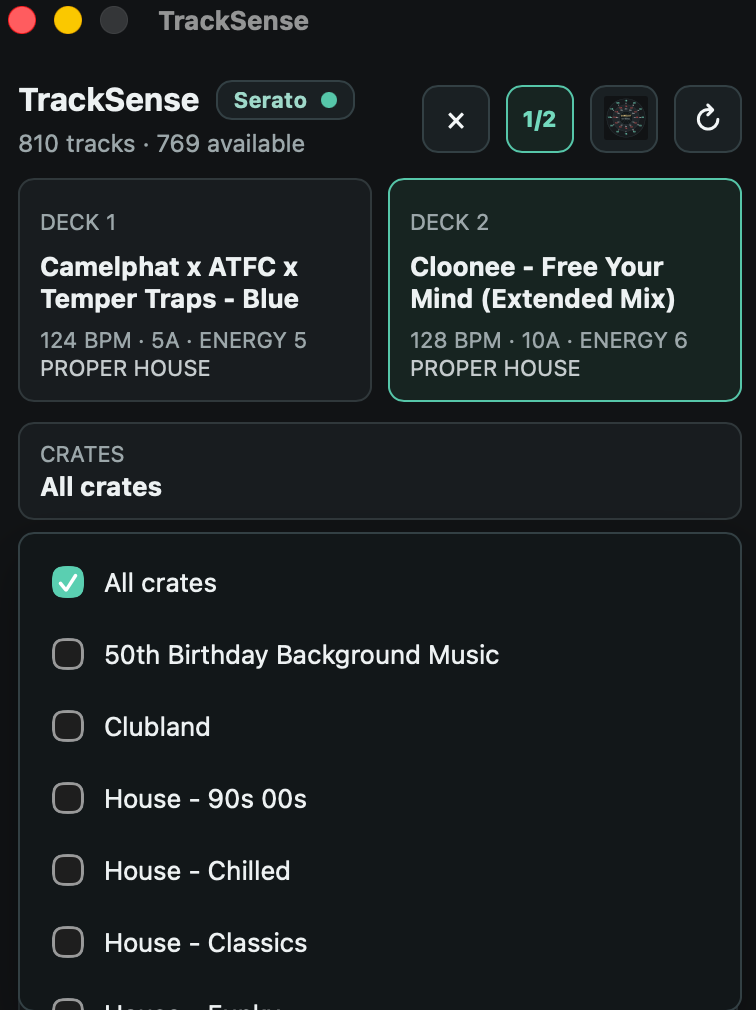
Build crates around decisions you make in a set
A crate is most helpful when it answers a practical question. Instead of one enormous house crate, create focused groups such as warm-up house, vocal house, peak-time rollers, familiar singalongs or late-night closers. They do not need to be rigid genres. The aim is to create places you can trust when the set reaches a particular mood, energy level or time of night.
Event crates are equally useful. Before a gig, make a small crate for the venue, client or style of booking, then add the records that are likely to work there. This reduces the amount of searching required in the moment while leaving your broader library available when you need to change direction.
Make sure the library information is dependable
Crates work best when the tracks inside them have reliable BPM and key data. Analyse new music before the gig, and correct obvious errors where they matter. Consistent artist and title fields also make text search useful when you remember part of a record but not the exact name.
It is worth reviewing tracks that regularly behave differently from the rest of the crate: a tune that is much louder, has a long silent intro or enters with a vocal may need a cue point or a more specific home. Small preparation choices make a bigger difference to next-track selection than adding more labels for the sake of it.
Use a focused crate before opening the search wider
When there is a track playing, start with the crate that matches the current direction of the set. A smaller source produces more meaningful matches because every result is at least plausible for the room. You can compare key, BPM and energy without scrolling through hundreds of tracks that technically match but do not suit the moment.
Once the set needs a change, broaden the search deliberately. Switch to another crate for a planned lift, open a wider folder to explore, or move to all crates when you are looking for contrast. The sequence matters: begin with context, then expand only when the music calls for it.
Keep crates alive after each gig
Crates should improve over time. After a set, move the tracks that worked especially well into a dependable group and remove records that no longer fit. A short note in a track comment or a dedicated crate can capture the context: early terrace, peak club, after-hours, open-format or vocal reset.
Qoovio can use the crate or crates you choose as the source for its next-track suggestions. That means the scoring is applied to the music you have already decided belongs in the current situation, rather than treating your entire collection as one undifferentiated list.